Preclinical & Clinical Disease Research Unit
- Supports candidate compound selection and diagnostic technology development by precisely tracking and quantifying changes in biosignals (optical, molecular, metabolic, and structural signals) associated with disease onset, progression, and treatment response through clinical–preclinical linked disease research
- Performs multi-scale analysis of molecular signal distribution, tissue structure, and microenvironmental changes in lesions using multimodal analytical technologies such as optical, molecular imaging, and spectroscopy
Research Content
Evaluation of drug distribution and efficacy based on disease models
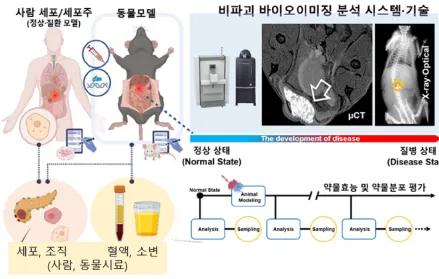
Biosignal analysis based on bioimaging technologies
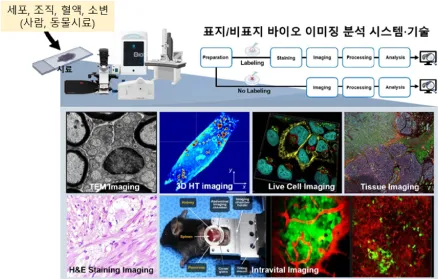
Research Infrastructure
Clinical–preclinical biosignal-based research infrastructure for disease and candidate compound evaluation
- Establishment and operation of various disease models (tumor models, aging models, genetically engineered models, etc.)
- Performs multi-scale biosignal analysis at the organism–organ–tissue–cell levels through multimodal optical, molecular, spectroscopic, and microscopy-based biosignal analysis infrastructure
- Possesses biosignal analysis technologies capable of non-destructively observing tumor microenvironment and lesion changes
- Secures technologies for photoreaction-based biosignal tracking, exosome isolation and analysis, real-time biosignal acquisition, and multidimensional biological tracking and structural analysis for precise detection of disease-related signals
- Through a clinical–preclinical linked biosignal analysis platform, long-term tracking and quantification of disease progression and treatment responses are performed
Development of an N-Cys-targeted DNFC staining method Redox Biology, IF=11.9, top 4.6% in JCR, March 2025
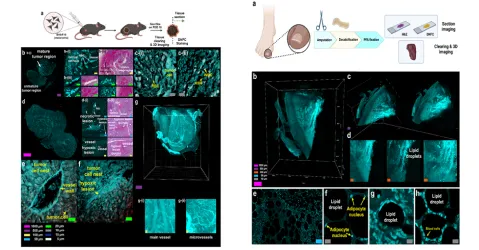
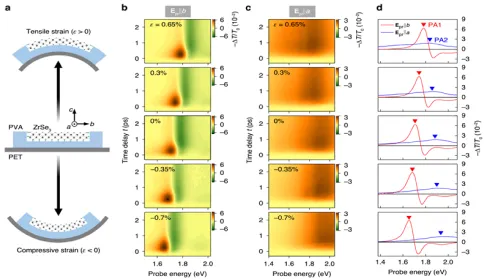
Identification of electronic behavior anisotropy for the development of new spectroscopic analysis technologies
Light
Science & Applications, IF=20.6, top 3.2% in JCR, September 2024
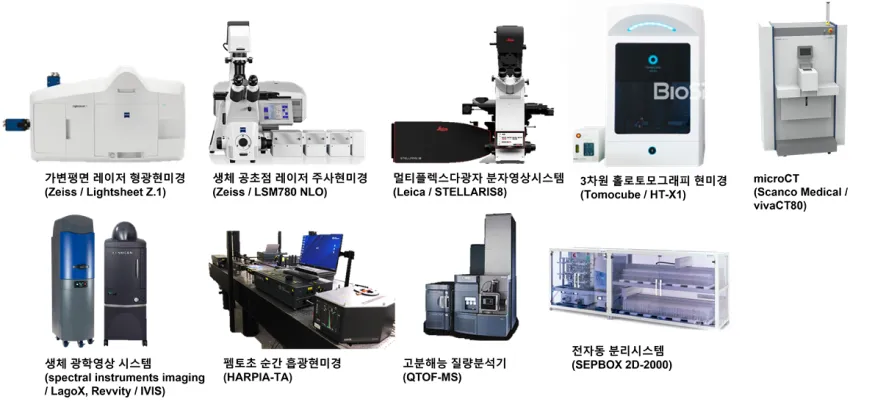
Research equipment infrastructure of the Clinical and Preclinical Disease Research Unit